Frisco, TX · When the ducts are the actual problem
Ductwork replacement and redesign in Frisco
A new air conditioner cannot deliver air the duct system cannot carry. If you have a room that has never been comfortable, replacing the unit will not fix it — and we would rather tell you that before you buy one.
Load calculation
We measure the house — square footage, orientation, glazing, insulation, duct capacity. Not the sticker on your old unit.
Fixed written quote
One number, itemised, valid for 30 days. No tier sheet, and nobody stays at your kitchen table until you sign something.
Install day
Most single-system changeouts are one day. We pull the permit, haul the old equipment, and register the warranty.
What a duct job costs in Frisco
Scope decides the number here more than home size does. Most Frisco homes need sealing or a partial replacement rather than the full job.
- A free load calculation on site. About forty minutes. Square footage, orientation, glazing, insulation, ceiling heights and duct capacity.
- One fixed written quote, itemised, valid for 30 days. It does not move on install day unless you change the scope.
- No good / better / best tier sheet. Tiered pricing is a negotiating tactic dressed up as a choice.
- Permit, inspection and haul-away included in the quoted figure, not added afterwards.
- No presentation. Nobody stays at your kitchen table until you sign something. If the number does not work, that is a normal outcome.
The symptoms that mean ducts, not equipment
One room is always wrong
The classic is a bonus room over the garage, or an upstairs back bedroom that runs five degrees warm all summer. Almost always a duct run that is too long, too small, or crushed — and no amount of new condenser fixes it.
The system runs constantly and still cannot get there
If the equipment is sized right and still cannot keep up, the air is not arriving.
Returns that are obviously too small
A three-ton system needs roughly 1,200 CFM of return air. A single undersized return grille is one of the most common faults in 2000s builder construction, because return ducts are expensive and invisible on a walkthrough.
Dust, and rooms that smell like attic
Leaking return ducts pull unconditioned attic air — 150°F in a Frisco August, plus insulation fibres — straight into your system.
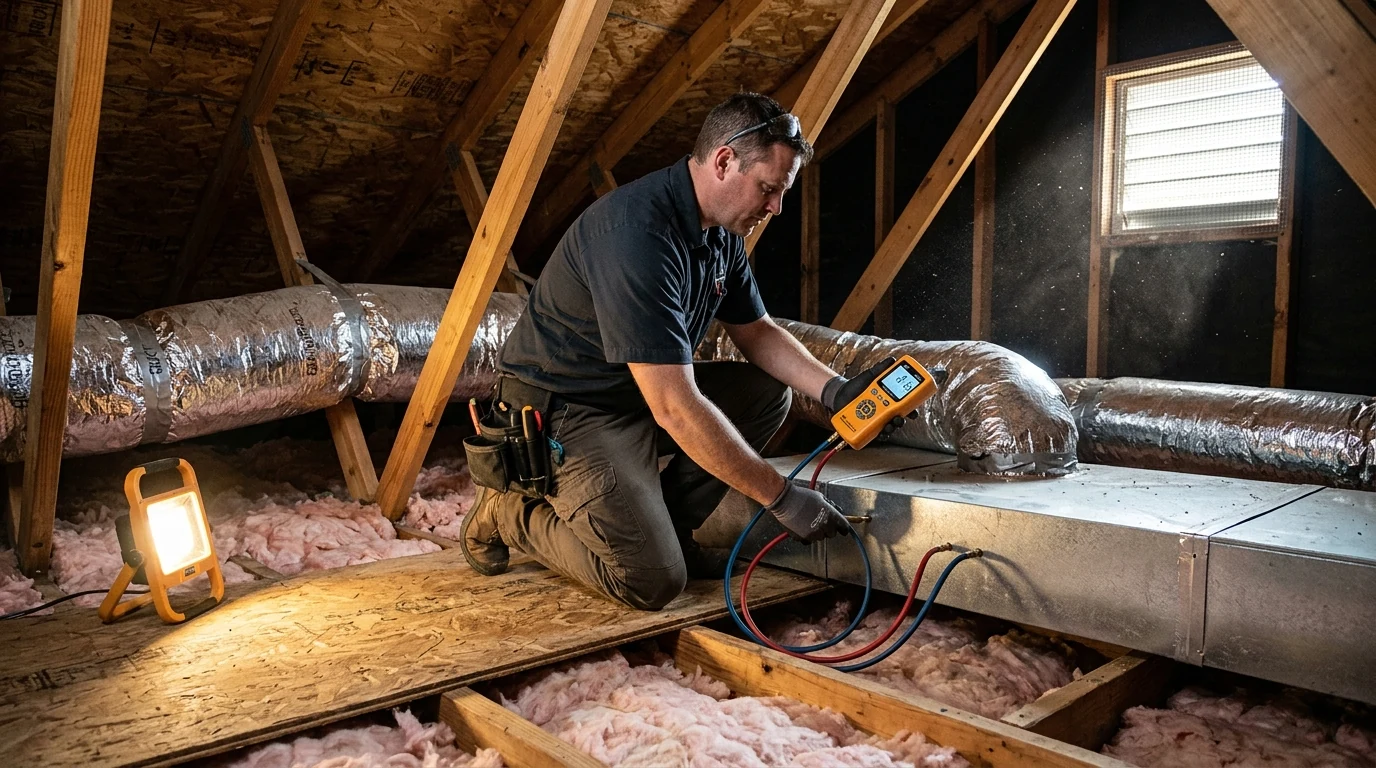
Static pressure, plainly
Think of it as blood pressure for a duct system. The blower pushes air; the ducts, filter, coil and grilles resist it. Static pressure is that resistance measured.
Most residential equipment is rated at 0.5 inches of water column. A great many houses measure well above that — sometimes double. When they do:
- The coil does not get enough air across it and can ice up.
- The system runs longer for less cooling.
- The blower motor works harder than it was designed to and fails early.
- The efficiency rating you paid for becomes theoretical.
Measuring it takes about ten minutes and two probes, and it is part of every load calculation we do. It is also the single most common thing skipped in a replacement quote — because a contractor who does not measure it never has to tell you about it.
Attic ducts in Texas heat
Nearly every Frisco home runs its ducts through an unconditioned attic, which in August is roughly 150°F. That means two things.
Insulation value matters more here than almost anywhere. R-6 flex was standard for years; R-8 is the sensible current minimum, and the difference across a long attic run is real.
Leaks cost double. A supply leak dumps cooled air into the attic. A return leak pulls 150°F attic air into the system, which the equipment then has to cool from scratch. Return leaks are worse, and they are the ones nobody looks for.
Old flex duct also sags between supports over twenty years. A sagging run develops belly kinks that restrict airflow without ever visibly failing.
Repair, seal, or replace?
We do not replace ducts by default — most Frisco homes do not need it, and quoting a full duct replacement alongside every system is a known way to inflate a ticket.
Seal and insulate
Where the layout is sound and the losses are joints and jackets. Cheapest option by a wide margin, and often gets most of the benefit.
Partial replacement
Where the trunk is adequate but specific runs are undersized, crushed or too long. This is the common middle answer.
Full replacement
Where the design itself is wrong — insufficient returns, undersized trunk, twenty-plus-year-old flex sagging throughout — or the ducts are contaminated.
Do it while the equipment is out
The cheapest time to do any of this is during a system replacement, because it saves a second attic mobilisation.
Frequently asked questions
How much does it cost to replace ductwork in Frisco?
Scope decides it far more than home size does — sealing and insulating a sound layout is a fraction of a full replacement, and most Frisco homes need the former. We measure static pressure and return capacity first, then quote only what is actually needed. Get my free quote.
Do I need new ducts with a new AC unit?
Usually not. We measure static pressure and return capacity as part of the load calculation — if the ducts can carry the airflow, they stay. If they cannot, you will know before you buy the equipment.
Why is one room always hotter than the rest?
Nearly always the duct serving it: too long, too small, crushed, or disconnected. New equipment will not change it, which is why it is worth diagnosing before a replacement rather than after.
How long does ductwork replacement take?
One to three days depending on scope and attic access. A return upsize is a few hours; a full dual-system replacement is the long end.
Can leaky ducts really raise my bill that much?
Yes. Duct losses in an unconditioned Texas attic commonly run 20–30% of system output. A return-side leak is worse than a supply-side leak, because it pulls 150°F attic air into the system for the equipment to cool all over again.
Find out what your house actually needs
A load calculation, a fixed written quote, and a straight answer about whether you should be replacing at all. Free, with no sales presentation attached.